Every so often a question comes up in the chat groups that never quite gets settled: to get the best out of 24GHz on tropo, is a 24GHz LNA at the feedhorn worthwhile? It's tempting to assume that improving noise figure buys you a better receiver, so you hear more — and that's clearly true on the lower microwave bands. But as this article shows with a full cascade calculation, the answer turns out to be more nuanced, and it's worth walking through the actual numbers before spending money on an LNA.
24GHz Receiver Noise Figure: Where We're Starting From
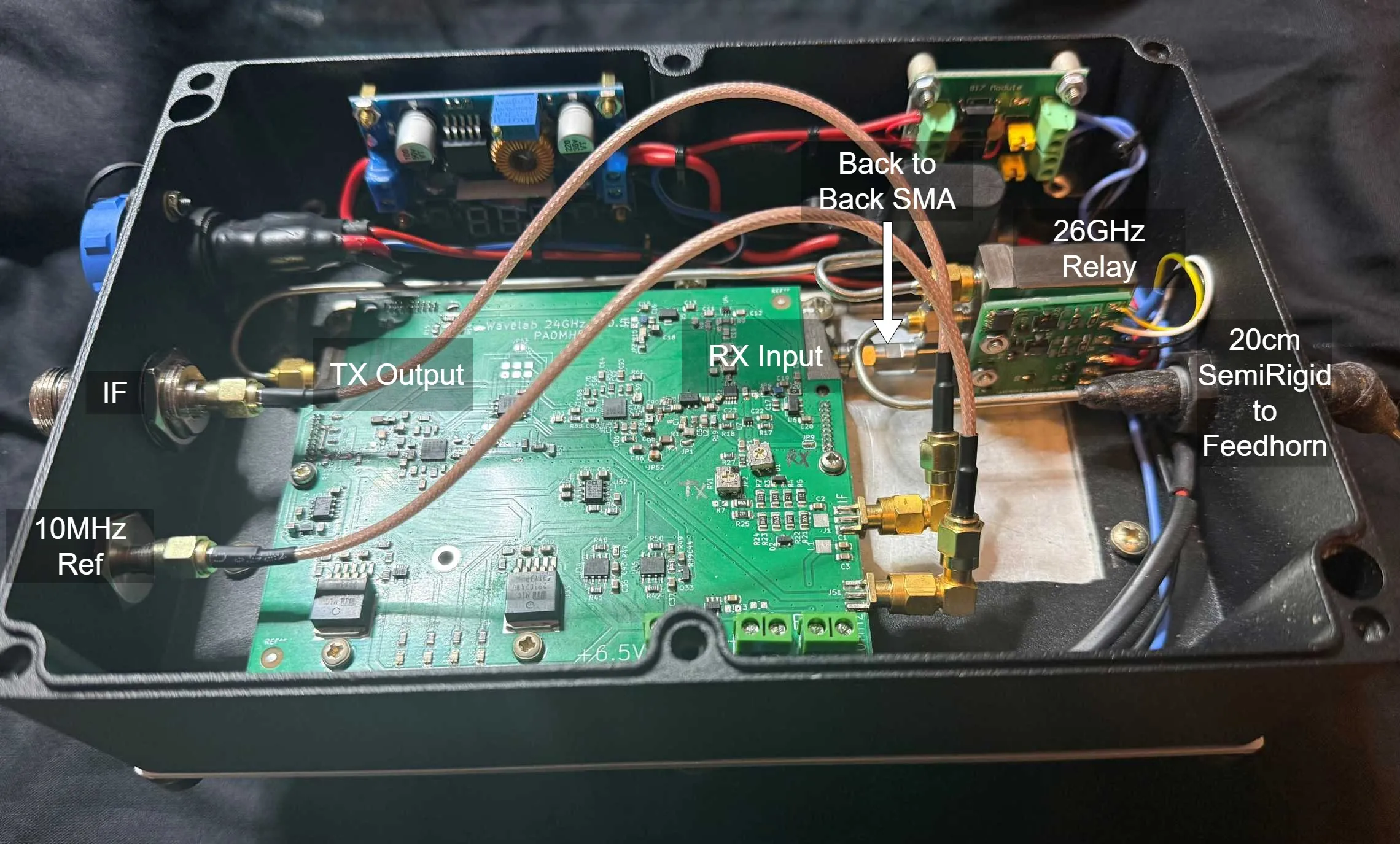
Before touching a cascade calculator, it helps to know where we're starting from. At the Ridgeway Microwave Round Table, I measured the noise figure of my Wavelab 24GHz system. This was done at the feedhorn — so it includes a 20cm semi-rigid cable terminated with SMA connectors, a 26GHz coaxial relay, and a back-to-back SMA adaptor between the Wavelab RX input and the relay.
The result was a 4.5dB noise figure, which is consistent for a Wavelab (XP version) based 24GHz system. Several other stations have reported 3.5–4dB noise figure measured directly at the Wavelab module itself — any losses ahead of the receiver (cable, connectors, relay) add directly onto that figure.
Why Noise Figure at 24GHz Matters More Than at 10GHz
The physics is straightforward once you know where to look. The 24GHz amateur allocation sits close to the 22.235GHz water vapour absorption line. Being near a resonance means the atmosphere doesn't just attenuate the signal more — it also radiates more noise at that frequency, because a lossy medium is a noisy medium (Kirchhoff's law of thermal radiation, if you want to investigate this more). Practically, clear-sky zenith (straight up) noise temperatures at 24GHz typically run 60–120K, compared with something closer to 20–30K at 10GHz — call it three to four times hotter at the zenith.
As you tip the antenna toward the horizon, airmass increases for both bands, so both get noisier. But 24GHz, having a head start at zenith, reaches saturation — becoming optically thick, and approaching the full ~270–290K physical temperature of the air — at a much shallower elevation angle than 10GHz does.
So, at the true limit, as elevation approaches zero, both bands do converge toward the same physical-temperature ceiling: eventually any frequency's path becomes optically thick enough to radiate like the air itself. But at the elevation angles actually used for tropo work — a few degrees above the horizon — 24GHz is typically already sitting close to that ~270K ceiling, while 10GHz is still well below it. As a rough order of magnitude, that's something like 100–250K at 24GHz against 20–90K at 10GHz over the same few-degree range, depending on humidity.
That last point matters a lot for tropo work specifically, because long-haul tropo paths are, almost by definition, low-elevation paths. At low angles the beam is transiting a long, dense slab of troposphere, humid air pushes the noise temperature up further, and any spillover past the edge of the dish picks up warm ground at roughly the same 290K. Put together, the antenna temperature on a real hilltop-to-hilltop 24GHz DX path can be close to the ambient temperature of 290K even on a clear day.
That's the crux of the problem: when the sky itself is nearly as noisy as a matched resistor at room temperature, no amount of receiver front-end wizardry can get you below that noise floor.
Cascade Calculation: What a 24GHz LNA Would Buy You
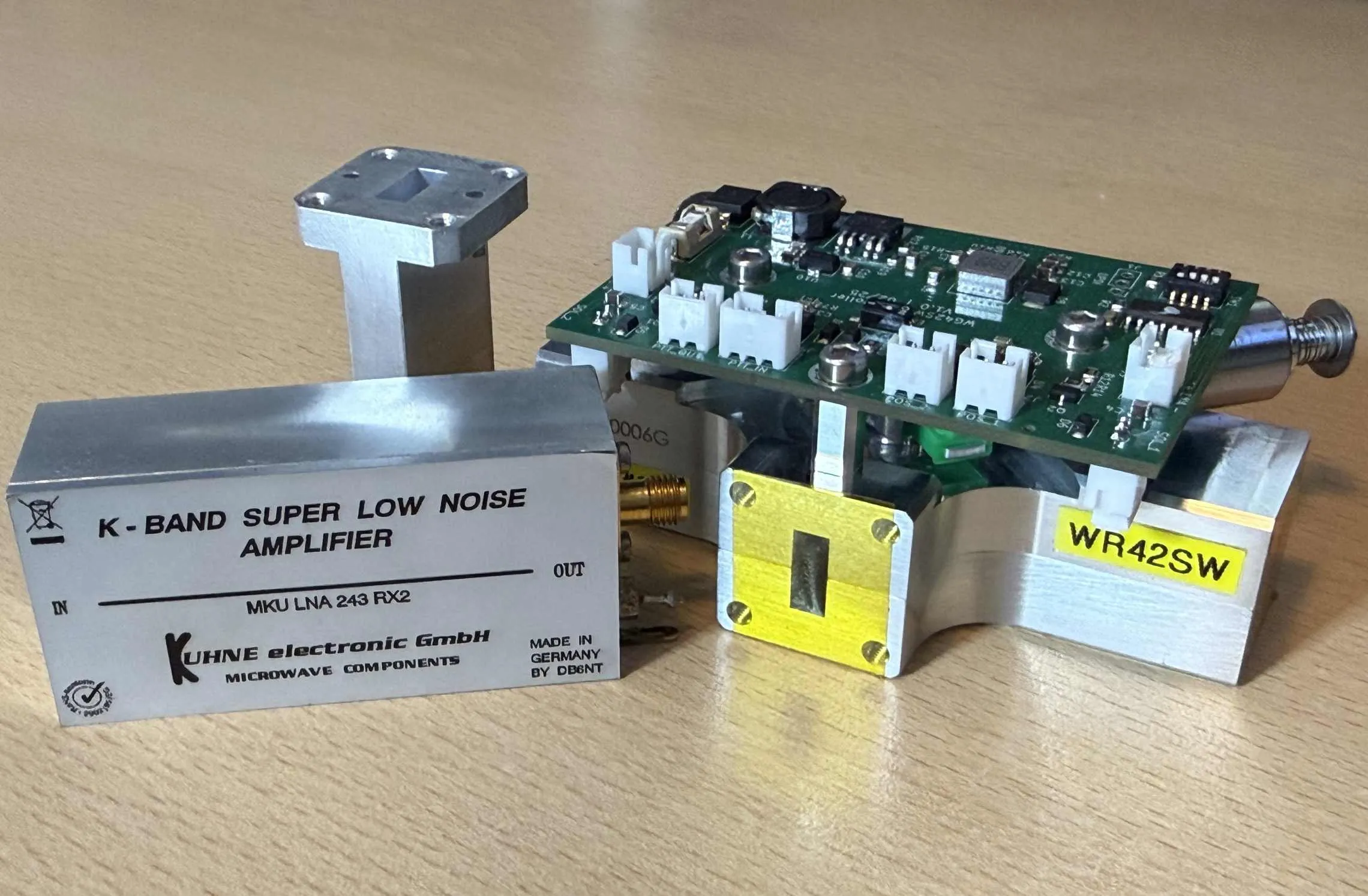
To put a number on it, I considered adding an "EME-grade" front end ahead of a Wavelab module with a 3.5dB noise figure: a waveguide switch from PL0PLY mounted right at the feed — specified at up to 0.3dB insertion loss — followed by a waveguide-input LNA (coaxial output) from Khune Electronics offering 26dB of gain and a 1.5dB noise figure. Working out the resulting cascade noise figure is done with the Friis noise formula:
$$F_{\text{total}} = F_1 + \frac{F_2 - 1}{G_1} + \frac{F_3 - 1}{G_1 G_2}$$
where each F and G is expressed as a linear ratio, not in dB — that trips people up more than anything else in this calculation. Converting dB to linear uses: \( F = 10^{\frac{\text{dB}}{10}} \) and \( G = 10^{\frac{\text{dB}}{10}} \) for gain the same way.
Let's work through it stage by stage:
Switch (stage 1): 0.3dB loss → \(F1 = 10^{\frac{\text{0.3}}{10}} = 1.072 \). A lossy passive component has gain less than one, so \( G_1 = \frac{1}{F_1} = 0.933 \)
LNA (stage 2): 1.5dB NF → \( F_2 = 10^{\frac{1.5}{10}} = 1.413 \). Gain of 26dB → \( G_2 = 10^{\frac{26}{10}} = 398 \).
Wavelab (stage 3): the 3.5dB figure gives \( F_3 = 10^{\frac{3.5}{10}} = 2.239 \), referred to its own input.
Plugging into Friis: \( F_{\text{total}} = 1.072 + \frac{1.413 - 1}{0.933} + \frac{2.239 - 1}{0.933 \times 398} \approx 1.52 \)
Converting back to dB: \( 10 \cdot \log_{10}(1.52) \approx 1.81\text{ dB} \).
Worth flagging: the exact result is sensitive to the switch's real insertion loss, which I haven't measured. At the maximum 0.3dB rating it lands at 1.81dB; a lower real-world figure may be around 0.2dB which brings it down nearer 1.71dB. Either way, replacing my relay and semi-rigid cable with this EME-grade front end would drop system noise figure from 4.5dB to somewhere in the 1.6–1.8dB range — a genuinely large improvement on paper.
Noise Figure vs System Noise Temperature: Why the Improvement Shrinks
Noise figure only tells part of the story. What actually determines your signal-to-noise ratio is the total system noise temperature — the antenna/sky contribution plus the receiver's own contribution — and that's where the LNA's advantage gets diluted.
Receiver noise temperature converts from noise figure using T_rx = 290 × (F − 1), with 290K as the standard reference temperature:
Current setup: \( F = 2.818 \text{ (4.5dB)} \rightarrow T_{\text{rx}} = 290 \times 1.818 \approx 527\text{K} \)
With switch + LNA: \( F = 1.517 \text{ (1.81dB)} \rightarrow T_{\text{rx}} = 290 \times 0.517 \approx 150\text{K} \)
Now add the antenna/sky temperature. For a low-elevation tropo path where the antenna is looking through a long slab of humid troposphere, that figure approaches the 290K used earlier:
System temperature now: \( T_{\text{sys}} = T_{\text{antenna}} + T_{\text{rx}} \)
Before: \( 290 + 527 = 817\text{K} \)
After: \( 290 + 150 = 440\text{K} \)
The SNR improvement in dB is \( 10 \cdot \log_{10}\left(\frac{T_{\text{sys, before}}}{T_{\text{sys, after}}}\right) \): \( 10 \cdot \log_{10}\left(\frac{817}{440}\right) = 10 \cdot \log_{10}(1.86) \approx 2.7\text{ dB} \)
So, despite the noise figure itself improving by nearly 2.7dB (4.5dB down to 1.81dB), the real-world SNR gain on a hot, low-elevation tropo path comes out at only around 2–3dB — because the sky, not the receiver, is now the dominant noise source. It's a textbook case of diminishing returns: once the external noise temperature is comparable to or greater than the receiver's own contribution, cutting receiver noise further buys progressively less.
It's worth noting this figure is closer to a worst-case, near-horizon number. Point the same setup higher in the sky, where clear-sky temperatures might sit closer to 90–150K rather than 290K, and the arithmetic actually favours the LNA more, with improvements approaching 4dB or more — simply because the receiver's own noise becomes a larger fraction of a cooler total. For tropo, though, low elevation angles are necessary, which is exactly why the benefit shrinks back toward that 2–3dB figure in practice.
Perform your own calculation
If you would like to perform this calculation yourself, or modify it for your own system then there is our Cascade Calculator Tool that can help you do this without the maths. I have reproduced it below with these figures loaded so you don't have to leave this page.
Cascade Calculator

Add each stage of your RF front end in signal order, with its Gain, Noise Figure, and (optionally) P1dB and IP3, all in dB / dBm. For a passive lossy stage (a switch, relay, or cable), enter its loss as the Noise Figure and as a negative Gain, and leave P1dB / IP3 blank — they're optional, and a blank field is treated as "not limiting."
| # | Stage name | Gain (dB) | NF (dB) | P1dB (dBm) | IP3 (dBm) |
|---|
Stages are cascaded in the order listed, from the antenna/feed end first through to the final stage. Leave the antenna temperature blank to skip the system-temperature figure.
| Stage | Cum. Gain (dB) | Cum. NF (dB) | Cum. OIP3 (dBm) | Cum. OP1dB (dBm) |
|---|
Friis cascade: F_total = F1 + (F2−1)/G1 + (F3−1)/(G1·G2) + … OIP3/OP1dB use the standard reciprocal-sum combining rule referred to the system output. "Cumulative" columns show the running system figure considering only the stages up to and including that row.
Beyond the 24GHz LNA: Where Else to Invest
Given a roughly 2–3dB gain for the cost and complexity of a waveguide switch and low-noise amplifier, it's worth asking what else 2–3dB might buy. A few candidates that cost little or nothing:
Feed illumination and spillover matter more than most people credit. Every bit of spillover past the dish edge picks up ground noise at close to 290K, directly adding to the antenna temperature term above — which is precisely the term that limits how much an LNA can help in the first place. An offset-fed dish sidesteps this neatly, since spillover points at cold sky rather than warm ground.
Dish size is another lever, though practically a limited one. Beyond roughly 50cm at 24GHz, pointing accuracy becomes the bigger problem — a larger dish you can't reliably point is worse than a smaller one that gets aligned quickly and produces contacts. Rob G7MHF described exactly this whilst out portable: running a 60cm dish alongside someone else on a 30cm dish, he'd still be hunting for the signal while the 30cm station was already working the station. The larger dish simply took longer to point accurately, and stations would sometimes give up or want to move on before a contact was made.
And finally, propagation still dominates everything. Dry-air conditions on the high microwave bands can extend paths dramatically — for example, a tropo reception report earlier this year from G4FRE, copying the ON0UCL beacon at 511km. Had he been able to complete a QSO, it would have rewritten the DX record. No LNA gets you that; only the right conditions do. Perhaps the better investment is 24GHz capability from home, or at least keeping an eye on a WebSDR for enhancement and being ready to go out portable.
Is a 24GHz LNA Worth It? The Bottom Line
An LNA at the 24GHz feed is not a bad idea — the cascade maths shows a real, calculable noise figure improvement, and in less extreme, higher-elevation EME conditions it earns its keep easily. But for the near-horizon, long-haul tropo work, the atmosphere itself sets a noise floor that swamps a good deal of that improvement, capping the practical gain at around 2–3dB. That's genuinely useful — but it's roughly the same order of improvement available from better feed illumination, a sensibly sized and easily pointed dish, or simply waiting for a dry, stable high-pressure system to move in. Any of those routes gets you comparable decibels without the waveguide switch and LNA invoice.