
If you're planning to build or adapt a feed for a satellite dish, the single most useful thing to know about that dish is its f/D ratio — the focal length divided by the aperture height. It tells you how deep or shallow the dish is, and that shape determines what kind of feed will illuminate it properly. Get it wrong and you'll either spill signal past the edge of the dish, picking up extra noise, or under-illuminate the rim and lose gain — the f/D ratio is what any decent feed design is built around.
The trouble is, unless a dish came with its focal length printed on a label, you're rarely just handed this number. What you can measure directly, with nothing more than a tape measure and a straightedge, is the dish's height and how deep it curves. The calculator below turns those two measurements into a proper f/D figure.
What It Works Out
Enter a couple of straightforward measurements and it calculates:
If you already know the focal length — from a spec sheet, or by finding it with a sun focal point test — you can enter that directly instead and skip the depth measurement.
When To Use It
How to Measure Your Dish
Two measurements, both taken directly on the dish itself — not once it's mounted, since a dish's focal length and depth don't change depending on what angle it happens to be pointed at.
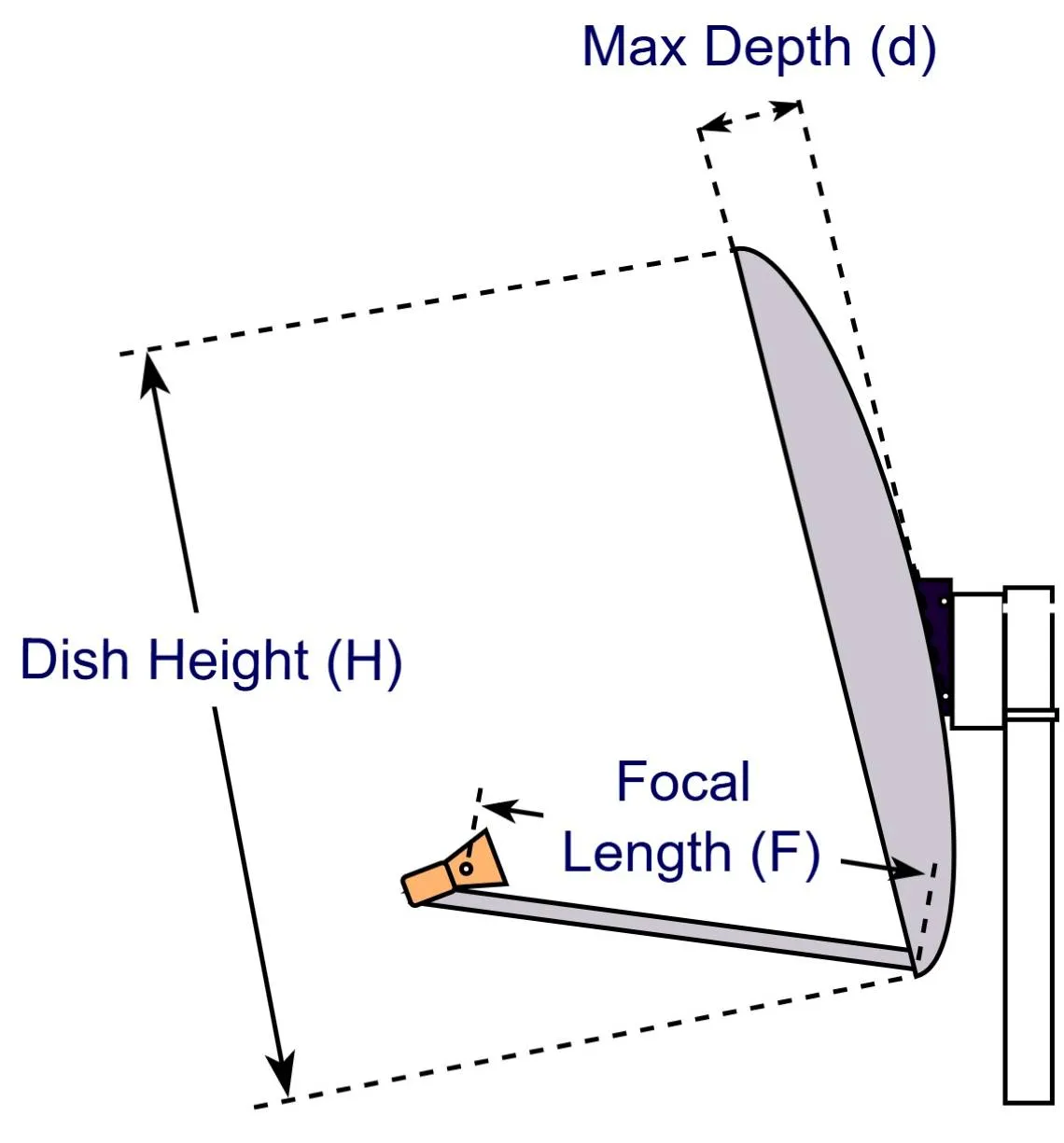
Height (H): the straight-line distance from the bottom edge of the dish to the top edge, along its long axis — the same direction the feed arm runs.
Max depth (d): lay something straight across the dish — a ruler, a length of wood, a broom handle — resting on the top and bottom edges. Measure the gap from that straightedge down to the deepest point of the curved surface underneath it.
Offset Dish f/D Calculator

Work out your dish's focal length and f/D ratio from a height and a max-depth measurement, or from a known focal length.
Use any unit you like — mm, cm, inches — just use the same unit for every field. Only the ratio matters.
Assumes the dish's near edge sits close to the true parabola vertex — true for most small offset dishes — so treat this as a close estimate rather than an exact figure.
A Note on Accuracy
Offset dishes are asymmetric — the true geometric centre of the parabola isn't actually on the visible dish surface at all. This calculator works from the practical assumption that the dish's near/bottom edge sits close to that true centre, which holds well for most small offset satellite dishes. Treat the result as a close, reliable estimate rather than an exact figure.