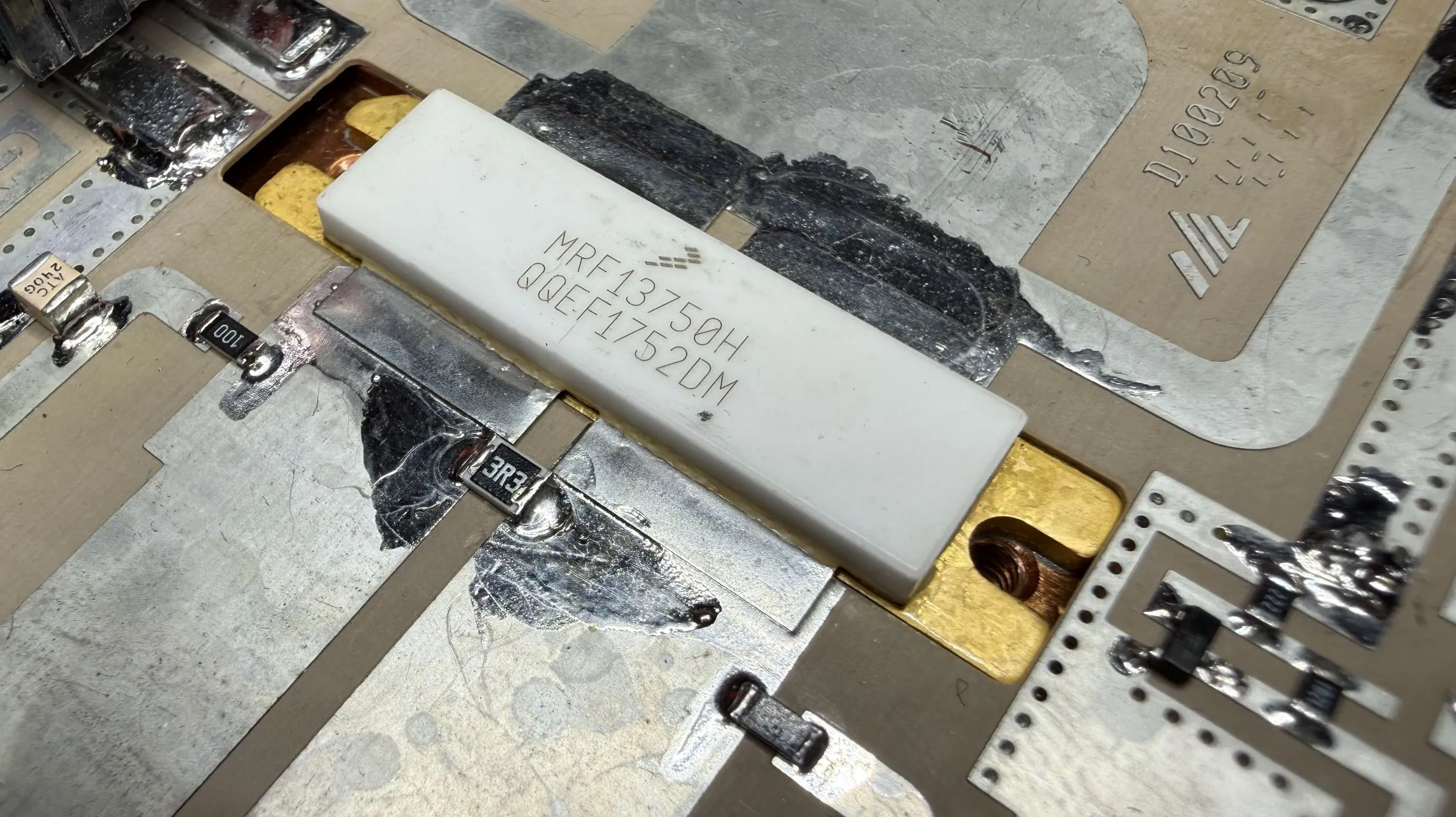
For decades, anyone building or repairing a solid‑state RF power amplifier would almost certainly encounter a transistor with Motorola DNA. That lineage of Motorola, Freescale and finally NXP — is now reaching its conclusion.
A Brief History
Motorola’s semiconductor division created the iconic MRF‑series RF power transistors, devices that became ubiquitous in amateur radio amplifiers, broadcast transmitters, military radios and cellular base‑station equipment. In 2004 the division spun off as Freescale, and in 2015 it merged into NXP. Because NXP already had a strong RF power portfolio — notably the BLF‑series used widely in base stations — the merger would have given NXP a dominant position in that market. Competition regulators required NXP to divest one of its RF power businesses, and the result was the formation of Ampleon, which inherited the BLF line.
Despite the corporate reshuffling, the Motorola lineage remained easy to recognise with some additional prefixes evolving over time as new series of transistors were introduced (AFT, MRFE, MRFX), but the underlying MRF prefix stayed intact.
Why was LDMOS so Important?
The arrival of LDMOS transformed high‑power HF, VHF and UHF amplifier design. Compared with bipolar devices, LDMOS parts were more rugged, affordable and available across a wide power range. Their gain was higher than VDMOS transistors and as they developped higher ruggedness, the devices started to replace VDMOS in industrial applications as well.
This now made them the go‑to choice for military, commercial and industrial applications as well as amateur radio RF power stages.
NXP continued to advance the technology. Its 65 V LDMOS process, introduced in 2017, enabled devices such as the MRFX1K80H, capable of 1800 W from a single push-pull transistor. Crucially, the 65 V parts were pin‑compatible with existing 50 V devices, allowing designers to reuse established PCB layouts. Existing power supplies could be turned up to their maximum, often around 55V which allowed designers to maintain some headroom in breakdown voltage, but increase the output power of their PA.
A Slow Wind-Down
The first public signs came in September 2020, when NXP announced it would scale down its Oak Hill fab in Austin, Texas, historically the main production site for its LDMOS RF devices.
The detail followed in July 2021, in a customer notice titled "Oak Hill Fab Radio Power Limited Availability Notification". NXP said it would stop fabricating the die for a group of legacy RF power devices by 1 December 2023. Newer LDMOS technologies were being moved to its fab in Nijmegen, in the Netherlands, but these older processes could not be transferred to any other fab. After the cutoff, supply would depend on a fixed inventory of wafers, built in advance from customer forecasts. The devices would stay active until stock ran low, with a formal discontinuation notice due no sooner than eighteen months before it ran out.
The Final Notice
On 31 March 2026, NXP published PCN 202603037DN, titled Final Radio Power Discontinuance Notice. The stated reason: continued ramp‑down of the Radio Power product line.
Status: full withdrawal, limited availability, sole sourceLimited availability: orders are first‑come, first‑served; the buy window may close early if inventory runs out
There is limited availability and some parts have already sold out. For the rest, the final last time buy date is 30 September 2026.
Alternatives to NXP
It's a quiet sunset for a product line that shaped a generation of RF power amplifiers, but there is still hope. Ampleon, which has its roots in Philips and was spun out of NXP's RF power business, continues to invest heavily in LDMOS. Its recent releases include the Advanced Rugged Technology (ART) series, whose high breakdown voltage and ruggedness have made it popular in HF, VHF and UHF amplifiers. Several of these devices are within reach of amateurs, and with some retuning they can replace NXP parts.
For help finding alternative devices, contact RFMW, Ampleon's specialist RF Distributor.